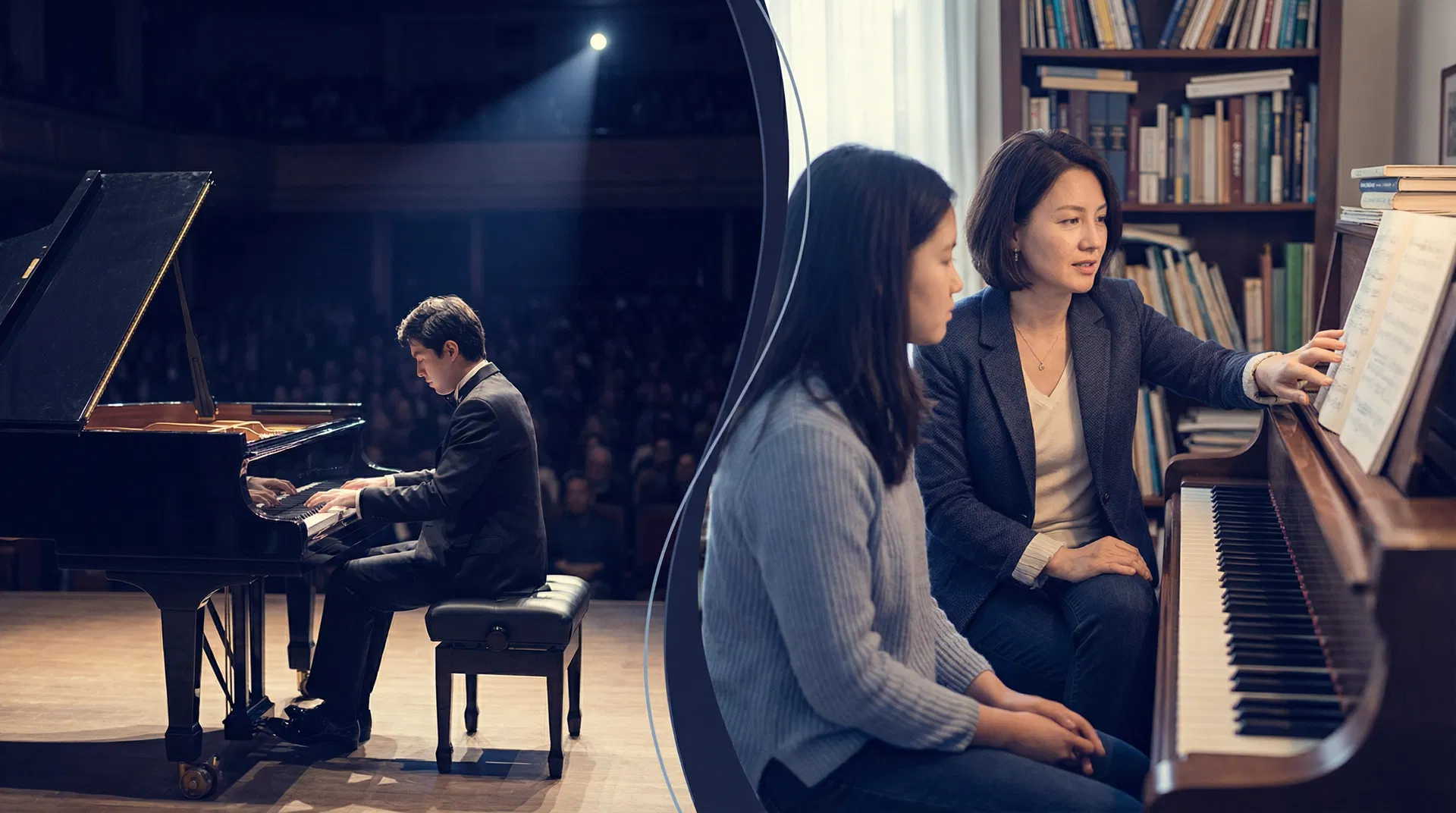
Piano Teachers with a Performance Background vs Without: How Much Does It Affect Students?
An Often Overlooked Question
In Hong Kong, when choosing a piano teacher for their child, many parents focus on: is the fee reasonable? Is the location convenient? Is the teacher patient? These are sensible considerations, but they often overlook a more fundamental question: does this teacher have real experience performing on stage?
This question may not seem crucial when a child first begins lessons. But when a student reaches an intermediate to advanced level and begins preparing for performance diplomas or competitions, the teacher's performance background becomes a key factor determining whether the student can make a true breakthrough.
What Is a "Performance Background"?
"Performance background" does not merely mean holding performance diplomas; it refers to whether the teacher has substantial experience performing in real concerts or competitions, and whether they have received rigorous performance training at leading conservatoires.
Specifically, teachers with a performance background typically possess:
- Completion of a performance degree at a leading conservatoire (for example, the Royal Academy of Music or The Hong Kong Academy for Performing Arts)
- Experience participating in international piano competitions
- Records of public performances in concert halls or music festivals
- Participation in masterclasses with world‑renowned pianists
What Can Teachers with a Performance Background Offer?
Teachers with performance experience have several clear advantages in their teaching:
Persuasive demonstration. When a teacher can demonstrate a passage themselves, allowing the student to hear what the music should sound like, the efficiency of learning increases significantly. Students are not left to imagine the sound; they have a real sonic reference.
Deeper musical understanding. A teacher who has performed a Beethoven sonata on stage will have a fundamentally different understanding of that piece compared with a teacher who has only taught it in lessons. The former can share the real sensations of performing and how to maintain musical integrity under pressure.
Precision in diagnosing and correcting errors. Teachers with performance backgrounds can quickly identify the root cause of a student's problem—whether it is technical, interpretative, or psychological—and provide targeted solutions.
Practical experience in exam preparation strategies. For students preparing for performance diplomas or competitions, a teacher's firsthand experience is an invaluable resource. They understand what adjudicators value most and how to prepare most effectively within limited time.
Limitations of Teachers without a Performance Background
This is not to say that teachers without performance experience are necessarily poor, but they do have limitations in certain areas:
First, they may be able to teach technique but struggle to convey the soul of the music. Technique can be achieved through practice, but musical expression requires a teacher who can demonstrate and impart what constitutes "good music".
Second, when students encounter highly demanding technical problems, teachers without personal performance experience may be unable to offer effective solutions because they themselves have never faced the same challenges.
Third, when preparing for performance diplomas or high‑level competitions, a teacher's personal performing experience is the most crucial resource. A teacher who has never competed will find it difficult to guide a student on how to perform at their best in a competitive setting.
Contrasting Real Cases
At Tin Pui Piano Academy, we have seen many students transfer from teachers without performance backgrounds. Although these students often reach a certain technical standard, their musical expression is severely lacking. They can play the correct notes, but their performances lack vitality and fail to move listeners.
After systematic training, these students often make significant progress in a short time—not necessarily a technical leap, but an expressive one. They begin to understand the importance of tone, consciously strive for richer musical expression, and start to present their own musical perspectives in performance.
How to Assess a Teacher's Performance Background in an Interview
When choosing a teacher, you can ask the following direct questions:
- "At which conservatoire did you complete your studies? Did you major in performance or in music education?"
- "When was your most recent public performance? Where was it held?"
- "Which piano competitions have you participated in?"
- "Which well‑known pianists have you studied with?"
- "How many of your students have successfully obtained performance diplomas?"
A teacher with a genuine performance background will be able to answer these questions clearly and confidently, and provide concrete examples.
Tin Pui Piano Academy's Faculty Standards
Mr Tin Pui Tang, Music Director of Tin Pui Piano Academy, was awarded a full scholarship to the Royal Academy of Music and studied with Israeli piano master Professor Arie Vardi. He also attended the inaugural Philadelphia Young Pianists Academy (PYPA) under Sergei Babayan, and took part in a masterclass organised by the Chopin Society in Hong Kong with Gary Graffman. This solid performance background is the foundation that enables him to effectively guide students to performance diploma level.
If you are seeking a piano teacher with genuine performance experience for your child, please contact Tin Pui Piano Academy to learn more about our faculty and programmes.
Planning advanced study or a performance diploma?
Explore the preparation approach first, then confirm individual arrangements and official requirements by WhatsApp.