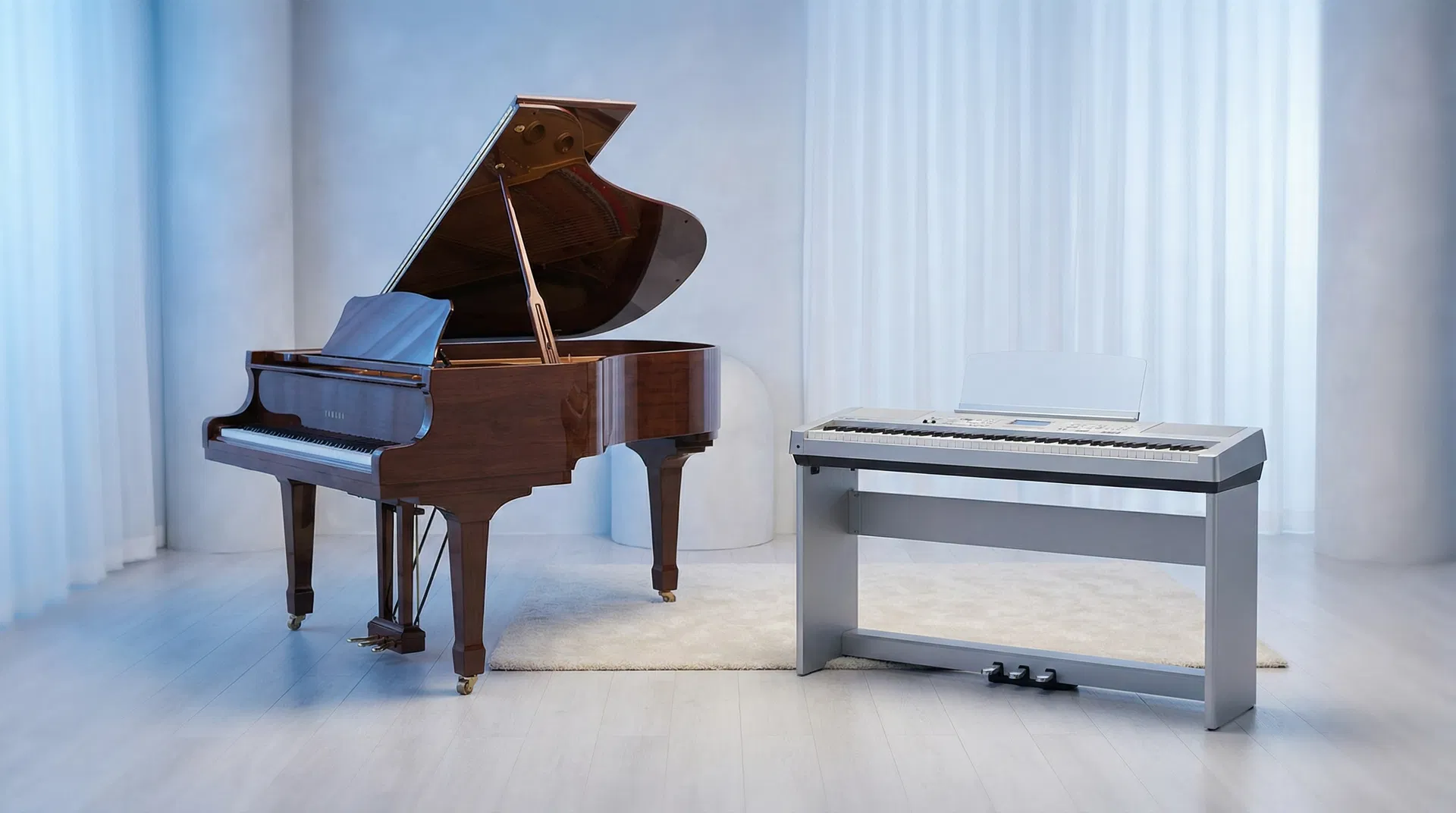
Should You Buy an Acoustic Piano or an Electronic Keyboard Before Lessons? One Decision That Shapes a Child's Entire Musical Journey
Keywords: piano or keyboard for beginners, choosing a piano in Hong Kong, disadvantages of keyboards, adult piano choice
Preface
Many parents ask before their child starts lessons: "Shall we buy an electronic keyboard first and, if they show interest, upgrade to a piano?" This seemingly sensible idea can, in fact, be the first step towards a child giving up on piano study. Tin Pui Piano Academy's Music Director, Tin Pui Tang, shares a real instrument‑selection story from six years of teacher–student relationship — a story about an adult pursuing a dream.
Which comes first, the chicken or the egg? The first decision in learning piano
Whenever new parents or students consult Tin Pui Piano Academy, they almost always ask the same question:
"Mr Tang, we want to try learning the piano but are not sure if they'll be interested. Should we buy an electronic keyboard first and, if they really like it, consider a real piano later?"
On the surface this sounds very reasonable — cautious, economical, flexible. But in over twenty years of teaching I have seen too many people with this "let's try" attitude give up part‑way through their piano journey.
The real issue is not whether it is an electronic keyboard or an acoustic piano, but the attitude with which one approaches it.
The real drawbacks of keyboards: it’s more than just tone
Many assume the difference between an electronic keyboard and an acoustic piano is merely that the former's tone is less authentic. This is a serious misunderstanding. The harm an electronic keyboard can do to piano learning runs far deeper than just tone.
1. Different key weight — finger strength cannot develop correctly
A real piano's keys have weight; producing sound requires finger strength, and different touch produces different volumes and tonal colours. This tactile feedback is fundamental for training finger independence, dynamic control and tonal variation.
Electronic keyboards have light, floaty keys that require almost no pressure. If a learner practises on a keyboard and their fingers get used to a "light touch", once they move to a real piano their finger strength is insufficient and their control of tone is effectively from scratch.
2. Pedal mechanisms are completely different
The sustain (damper) pedal of an acoustic piano is a precise mechanical system requiring nuanced foot control — how deeply you depress, how quickly, and when you release all affect the sound. Pedal technique needs to be cultivated from the start.
Most electronic keyboards' pedals are simply "on" or "off" and cannot train authentic pedal technique.
3. Lack of tonal feedback — the ear cannot develop properly
A piano's tone is "alive" — each note’s volume, colour and sustain are under the performer’s control. During practice, the ear constantly receives feedback and learns to distinguish what sounds pleasing from what does not.
An electronic keyboard's sound is fixed and electronically generated; however you play, the tonal response is similar. The ear cannot be properly trained in such an environment.
4. The deepest issue: attitude
This is the most crucial point.
When someone chooses to "buy a keyboard to try first", that decision already communicates: "I am not sure I can learn properly, so I'll try first."
This "let's try" attitude is often the root of giving up halfway.
A serious attitude brings serious results
I often tell my students: learning the piano is not something to "try".
A real acoustic piano is not just an instrument; it is a commitment — a commitment to yourself.
When you know there is a genuine piano at home, you approach practice differently. You recognise that this is serious, and you act accordingly.
Adam’s story: an adult’s journey in pursuit of a dream
I would like to share a true story about my student Adam.
Six years ago Adam joined Tin Pui Piano Academy as an adult. He had a deep love for the piano but the common worries adults have — is it too late? How far can I go?
He made the right decision: he bought a real upright piano.
Not an electronic keyboard, not a tentative "let’s try" — a genuine acoustic upright.
That decision changed everything.
Adam practised on a real piano; his finger strength developed correctly and his ear was trained by authentic tone. His rate of progress surprised everyone.
A few years on, something unexpected happened — the upright was no longer enough.
Not because the piano was broken, but because Adam had outgrown its capabilities. His technique, his demand for tonal nuance, and the repertoire he wished to perform required a grand piano.
At that point Adam’s family did something that moved him — they approved his dream to buy a grand piano and supported his path.
In the end Adam chose his dream instrument, a Shigeru Kawai grand piano — Kawai’s top handcrafted series, each instrument made by Japan’s finest artisans.
And this touching moment was witnessed by all his friends.

Tin Pui Tang, Music Director, with his student Adam beside Adam's new Shigeru Kawai grand piano.

Adam finally owns his Shigeru Kawai — "another dream come true."
On Instagram Adam wrote: "I finally own my Shigeru Kawai, it's my dream piano! It still feels unreal. Thanks to Big Brother for helping me choose the piano — as always, helping me fulfil my dream."
This story began with a simple decision: to buy a real acoustic piano.
So, what piano should you buy?
For beginners I recommend:
| Situation | Recommendation |
|---|---|
| Limited budget | Buy a second‑hand upright piano, ensuring key weight is normal and tone is accurate |
| Limited space | Choose a smaller upright (such as a Yamaha U1 or Kawai K‑200) |
| Comfortable budget | Consider an entry‑level grand piano — a better long‑term investment |
| Rental option | Some dealers offer piano rental services so you can rent a real acoustic piano initially |
Digital pianos versus keyboards
It is worth noting that a "digital piano" and a "keyboard" are not the same. High‑quality digital pianos (such as the Yamaha Clavinova series) have weighted keys that can simulate the touch of an acoustic piano and can serve as a transitional option where space or budget is very limited. Even so, they still cannot entirely replace the tonal and tactile experience of a real acoustic piano.
Conclusion: invest in the right thing
Learning the piano is a long journey, and its starting point often determines the destination.
Whether you are a parent choosing for your child, or an adult choosing for your own dream, treat this passion seriously. Give yourself or your child a real acoustic piano and let learning begin in the right environment.
You do not need to buy the most expensive piano at the start. But please do not use a keyboard merely to "try".
A serious attitude brings serious results.
If you have any questions about choosing an instrument, please contact Tin Pui Piano Academy. We are happy to offer professional advice.
Want to know more? Book a free assessment call
Have Music Director Tin Pui Tang personally assess your situation and devise a personalised learning pathway.
Author: Tin Pui Tang, Music Director, Tin Pui Piano Academy
Ready to begin your piano journey?
See how one-to-one study can begin from the learner’s level, goals and practice conditions.